

Life and Fate: What One Photograph Can Tell Us
What we founded while preparing material on the First World War:
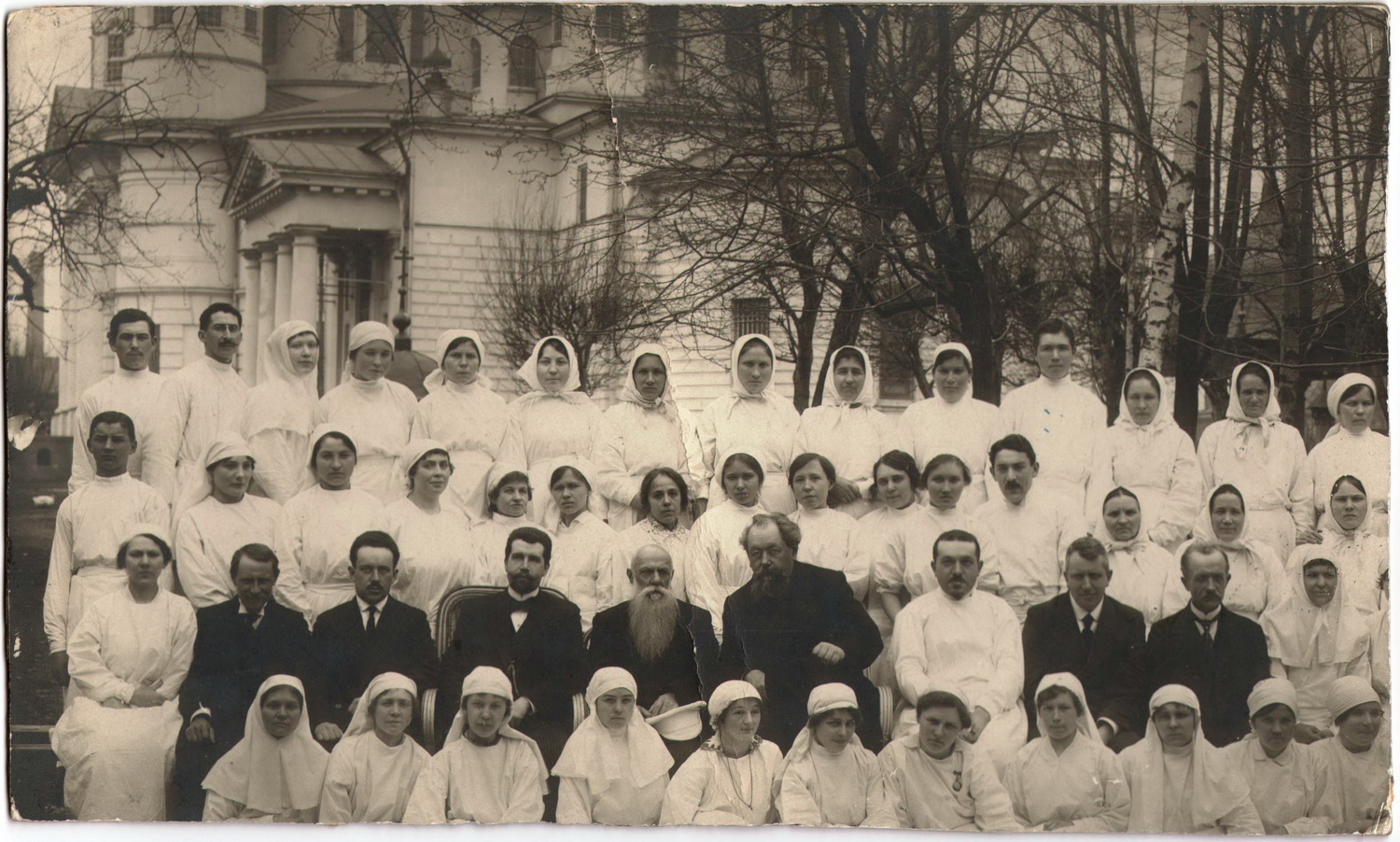
The outbreak of the First World War led to the widespread establishment of temporary hospitals and home-front collection points for donated army supplies. Such hospitals employed both professionals and those whom we would now call volunteers. In Moscow, at Rogozhskaya Zastava, temporary military distribution hospitals were opened in the medical supply warehouses of the Russian Red Cross and on the premises of the Kristall distillery.
In the center of this photograph is Dr. Sergey Puchkov, a member of the Moscow City Duma. Next to him are probably his medical colleagues, junior medical staff, and volunteers. Second from the left in the back row is Alexander Shor (1876–1942), a graduate of the Moscow Conservatory and founder of the first private conservatory, known as “A. G. Shor’s Courses of Music, Opera, Drama, and Choreography.” During the First World War, Alexander Shor not only volunteered at the hospital but also actively participated in fundraising for Jewish refugees affected by the war.
His wife, Margarita Shor, was the daughter of Ilya Simonovich, a nephew of Vladimir Hirschman, an industrialist and patron of the arts, known for being one of the first to systematically collect works by contemporary artists, particularly members of the «Mir Iskusstva» circle. He was also a private friend of the painter Valentin Serov. After the death of the artist, who had become a pillar of Russian portraiture, Hirschman organized his first major posthumous exhibition.
After the end of the First World War, Ilya Simonovich remained in Moscow and worked as an accountant in various organizations, including A. G. Shor’s Courses, and never lost his family's interest in art. He bought art albums and books for his daughter Margarita (1903–1977), who showed promise in drawing and wrote poetry from a very early age. After graduating from the Golovachev Gymnasium in 1922, she was admitted to the art department of Alexander Shor’s Courses. The acquaintance between the young student and the elderly master led to an unexpected turn: Margarita and Alexander Shor got married.
After the birth of their two daughters, Margarita gave up painting and turned to writing poetry for children. Her poems were regularly published in the 1930s, and in 1934, under a pen name Margarita Ivensen, she joined the Writers’ Union. Alexander Shor, who was considerably older than his wife, died during evacuation in 1942. Margarita Ivensen worked as a translator and as a radio announcer and correspondent. She lived a long and productive life. However, her lyrical poetry for adults was never published during her lifetime. The book "A Room You'll Enter – I Won't Be There…", which brought together Ivensen’s surviving poems for adults and children, was published only in 2017, forty years after her death. Yet in popular memory, she remained the author of a single, much-parodied masterpiece: “When Lenin was a little boy, with a curly head, he too ran in his felt boots down an icy slide…”.
Over a hundred years separate the publication of this poetry collection from the photograph taken at Rogozhskaya Zastava – a hundred years of the history of one Jewish, yet very Moscow, family.