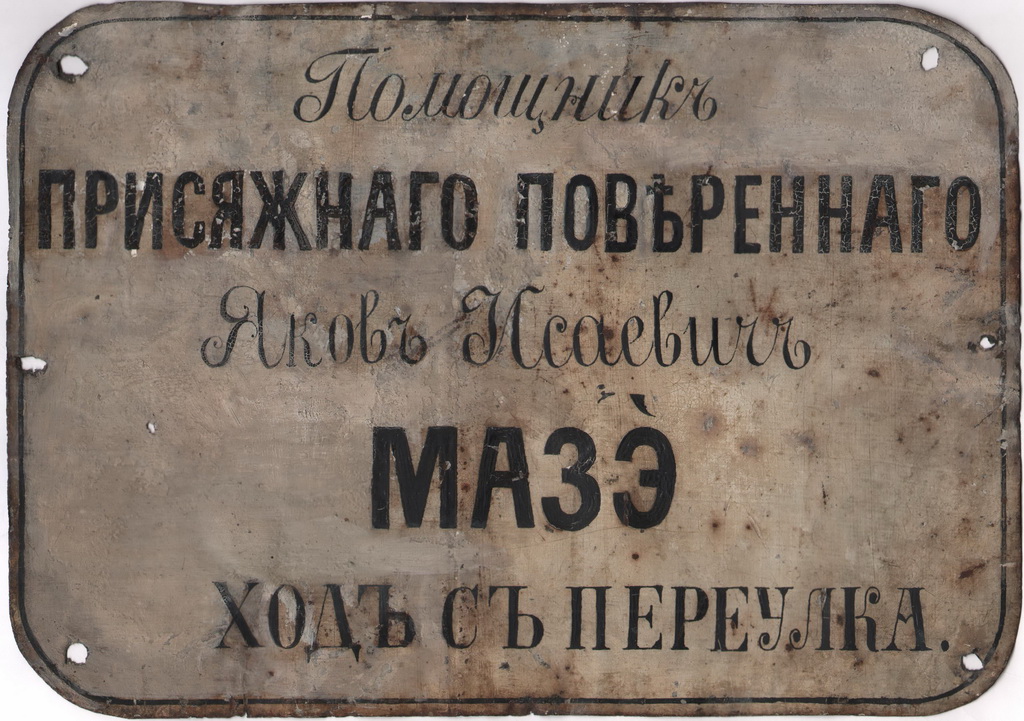



Assistant attorney receives clients at the given address
The items in the permanent exhibition of the Museum of Jewish History in Russia represent only a small portion of our collection and undergo a careful selection process. But this time it didn’t involve any hesitation, as the new exhibit directly relates to the Jewish community of Moscow, our hometown. Entering the museum hall, specially dedicated to this topic, visitors immediately are usually struck by an expressive portrait of the patriarch of Moscow Jewry – Chief Rabbi Yaakov Mazeh.
The plaque bearing the inscription "Assistant Attorney Yaakov Isaevich Maze" is not only a biographical detail from the life of a great man, but also an important testimony to the Jewish life beyond the Pale of Settlement. Yaakov Maze was born in Mogilev, into a religious family with ties to both the Lubavitch Hasidim and their opponents. This environment provided the boy with a very solid Jewish education, but in the second half of the 19th century this did no longer suffice for many young men.
In 1876, Mazeh enrolled in the Alexander Gymnasium in Kerch to obtain a secular education necessary for university entry requirements. He chose law as his future career and graduated from the Law Faculty of Moscow University in 1886. Afterwards Yaakov Mazeh worked for seven years as an assistant attorney, as the plaque testifies. It's important to understand that Jews had very limited residence rights in Moscow, and without a university degree Yaakov Mazeh would not have a chance to boast of an address on Gusyatnikov Lane near Myasnitsky Gate.
In the early 1890s, persecution of Moscow Jews intensified. Among many others, the city's chief crown rabbi Shlomo Minor and the treasurer of the Jewish community Isaac Schneider were expelled from the capital. The Moscow Jewish community held an election and appointed Yaakov Mazeh as chief crown rabbi in 1893. Candidates for this position were approved by secular authorities, as the crown rabbi's duties included civil status registry and interaction with state institutions. Mazeh, a graduate of Moscow University with an excellent command of Russian, more than met the state requirements.
After this appointment, the law faded into the background, but it never left Yaakov Mazeh's circle of interests. In 1918 he founded “Mishpat Ivri”, the Society for the Study of Jewish Law in Moscow. Yaakov Mazeh made his most important contribution to Russian legislation in 1913, serving as an expert witness for the defense in the famous Beilis Affair, an example of the so-called "blood libel." Rabbi Mazeh's task was to explain to the jury that the accusations of consuming Christian blood were absurd from the Jewish religious point of view. But Yaakov Mazeh's oratorical brilliance far exceeded formal expectations. His speech in defense of Beilis became a defense of the Jewish faith and, for the first time, resonated with the general public. Beilis's acquittal removed the "blood libel" from the legal framework and became a landmark event for Jews worldwide. Chief Rabbi Mazeh represented Moscow Jewry for over 30 years, tirelessly advocating for the community during pogroms, wars, and revolutions.